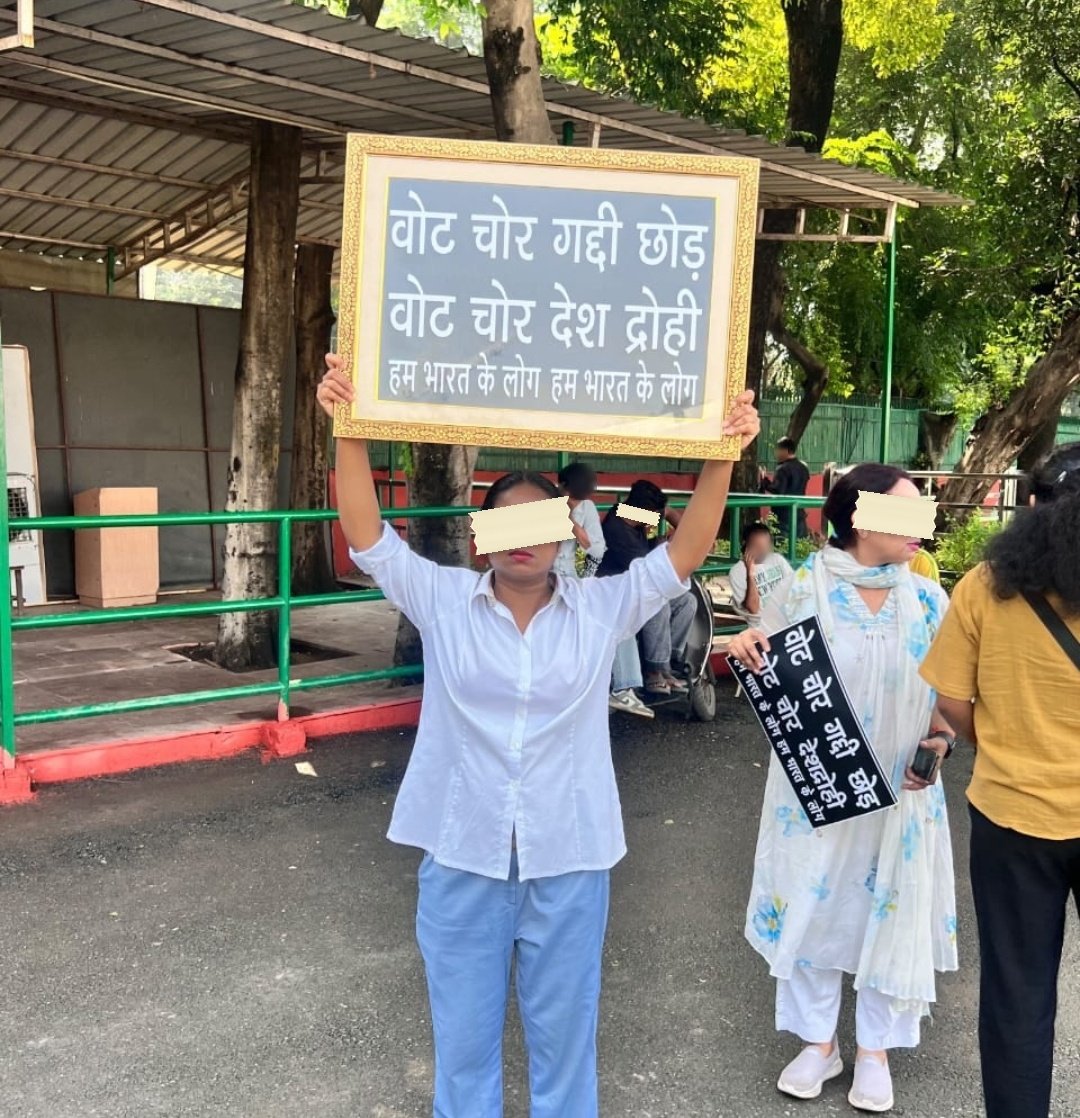
On Monday 12 October 2026 Rahul Gandhi led the INDIA bloc's Dilli Chalo march through New Delhi to the Supreme Court, demanding the removal of the Chief Election Commissioner, Gyanesh Kumar, over the revision of the electoral rolls. A plea against the Commission's chief was filed at the court the same day. The photographs in this album are from that march, and the first thing to look at in them is a picture frame.
A woman in a white shirt and pale blue trousers is holding it over her head with both arms straight up. It is a real frame, the ornate gilt kind sold in every market in the country for a wedding portrait or a god, with a cream mount inside it and glass over the top. Behind the glass is a grey-blue sheet printed in white letters: वोट चोर गद्दी छोड़, वोट चोर देश द्रोही. Vote thief, leave the seat. Vote thief, traitor. Underneath, in much smaller type and printed twice over, हम भारत के लोग, हम भारत के लोग.
Those four words are how the Constitution of India opens in Hindi. We, the People of India. The design sets them twice and we do not know why. It could be a signature, the name of whoever made the sheet. It could be the printer filling a line. It could be somebody saying it again because once was not enough. The photograph does not settle it and neither will this essay.
Beside her a second woman is carrying the same design at a quarter of the size, printed in black, bending slightly in her hand because it is a flexible sheet rather than a board. So there were at least two, and that means the design came from somewhere before it came to the march.

The frame is worth staying with, because a placard is built to be thrown away and a frame is built to keep something. Nearly everything else in this archive is cardboard, chart paper or a bedsheet, made the night before with whatever marker was in the house, and designed to last one afternoon in the sun. Putting a slogan behind glass does something else. It treats the sentence as an object that will go back on a wall afterwards, next to whatever else is framed in that house. Whether the person holding it thought about any of that, we have no way of knowing. The frame is in the photograph either way, and we have not come across another one in this archive.
Now the slogan inside it.
Vote chor, gaddi chhod is heard most often at protests called by the Cockroach Janta Party, the youth group that had been demanding the Chief Election Commissioner's resignation over the same electoral rolls. Two days before this march, on 10 October, the Delhi Police broke up a CJP protest before it began and detained thousands of people, among them the group's national convener Abhijit Dipke and its co-conveners Saurav Das and Ashutosh Ranka. The CJP's march never started. The INDIA bloc's march, on the Monday, drew a large crowd and reached the court. It was carrying the stopped march's words.
That borrowing was not hidden and it ran in both directions. One of the slogans most repeated on the Monday was jab jab Modi darta hai, police ko aage karta hai, whenever Modi is frightened he puts the police out in front, which had gained its traction at CJP protests earlier in the year. The most widely shared photograph of the day was of the Congress president, Mallikarjun Kharge, wearing a Batman mask, and CJP protesters had been turning up in Batman, Spider-Man and Superman masks for months. Earlier in the year both had been demanding the same education minister's resignation over the NEET paper leaks. Asked about the overlap, Rahul Gandhi said there were no parallel protests and that there was one protest, to remove Gyanesh Kumar and then the Prime Minister. That sentence is where this album gets its name.
A slogan is the cheapest thing in a movement to move and the hardest thing to own. It costs nothing to pick up, it carries no logo, and by the third week nobody can say who said it first. What the framed sheet records is the moment a phrase from a stopped protest turned up, printed and glazed, in the hands of somebody on a permitted one.

The rest of the album is a wide road and a lot of handwriting. In one frame the placards read DEMOCRACY UNDER THREAT, GenZ Will Fight for Every Vote, GenZ Rejects BJP-RSS, Bihar Ne Dekha Vote Chori, and जनमत की चोरी नहीं चलेगी, the theft of the people's verdict will not stand. Six placards, six different hands. The lettering on one has been ruled out in pencil first and gone over in blue; on another the words have been crammed in at the right edge because the writer ran out of card. Along the right side of the same photograph stands a line of Rapid Action Force personnel in blue-grey camouflage, at ease, backs to the crowd, which is its own fact about the afternoon.
In another frame people are sitting along the top of the police barricades with their legs hanging over the front, and the barricade under them is stencilled with the words Delhi Police and शांति, peace, which is the force's own word for the thing it is there to keep. A poster in orange and red poster paint is held up behind them reading PM IS ILLEGAL. That is the placard's charge and this archive reports it as the placard's.
In a third, someone in the foreground has a phone up and is filming the row of women in front of them, close enough that the phone screen is a second photograph inside the first. One of the women is wearing a printed T-shirt that says PM IS COMPROMISED. This is how the slogans get from one march to the other in the first place. Nothing in this album travelled by leaflet. It travelled because the crowd photographs itself, constantly, and a sentence that looks good on a screen is on a hundred placards by the following week.

Which brings the frame back. Of everything carried through Delhi that Monday, the object that had the most work put into it was the one carrying the least original line. Somebody chose a frame, bought a mount, had a sheet printed to fit it, and carried a pane of glass above their head through a police cordon on a hot afternoon, in order to say four words the Constitution opens with and a slogan that half the city was already shouting. The effort went into the holding, rather than into the saying.
That is not a small thing to have done. The words in the frame are the ones the country issued to itself in 1950, and the argument of the march was that they had been taken away by paperwork. Putting them behind glass and lifting them over a crowd is a way of saying they are worth keeping, and of saying out loud whose they are. The sheet in the smaller woman's hand says exactly the same thing on a flexible piece of plastic that will be creased by the end of the day. Both of them were at the court. Only one of them is going home to a wall.