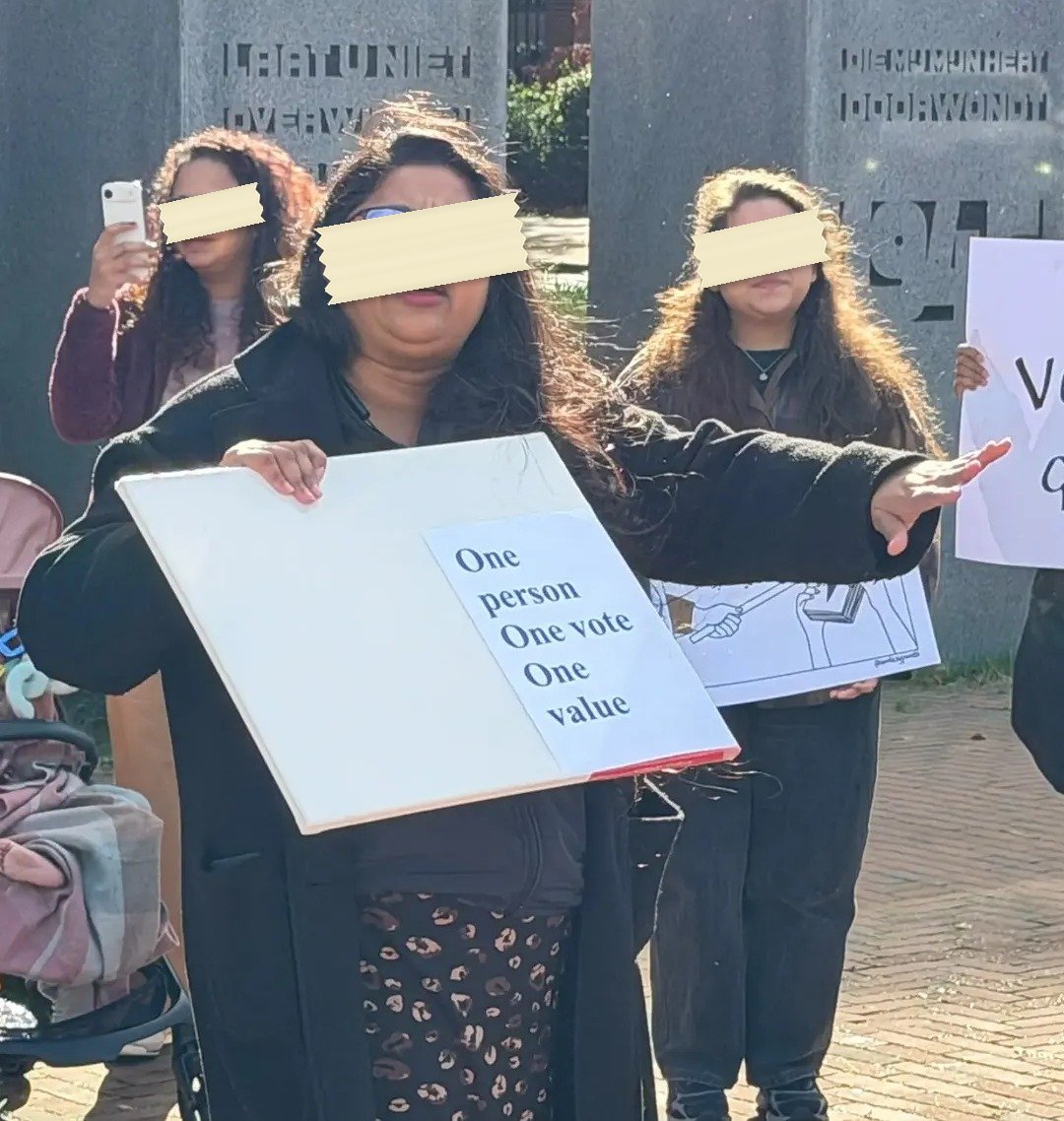
The photographs in this album were taken in October 2026 at The Hague, on the square called Carnegieplein, which is the open ground opposite the Peace Palace. Indians living in the Netherlands had come there over the revision of India's electoral rolls and what their placards call vote chori, the theft of votes. They brought a tricolour, a copy of the Constitution, and a stack of printed sheets.
Behind them, in several of the frames, is a wall of grey stone and a row of pillars with words cut into them. The words are legible in two of the photographs, across different pillars, and together they read: LAAT U NIET OVERWINNEN DOOR HET KWADE, MAAR OVERWIN HET KWADE DOOR HET GOEDE. Do not be overcome by evil, but overcome evil with good. On the pillar to the right of it, DIE MIJ MIJN HERT DOORWONDT, and under that, 1945.
This is the Haags Verzets- en Bevrijdingsmonument, the city's resistance and liberation monument. It was designed by Appie Drielsma and unveiled on 15 May 1992 by relatives of members of the Dutch resistance. There are four pillars and they stand for four parts of the city's population: neutral, Roman Catholic, Protestant and Jewish. The second pillar carries a line from Jewish tradition that is often found on gravestones. The third carries the line from Paul's letter to the Romans that is quoted above. The first and the fourth, read together, make the closing line of the sixth verse of the Wilhelmus in its original spelling: die tyrannie verdrijven, die mij mijn hert doorwondt. To drive out the tyranny that wounds my heart. The stone wall is meant as a dyke of unyieldingness. The monument is for the nearly twenty thousand residents of The Hague who died between May 1940 and the liberation in May 1945, more than sixteen thousand of them Jewish fellow citizens who did not survive the camps.
Whether anybody standing on that brick had read the pillars, these photographs cannot say, and this archive is not going to pretend otherwise. What they do say is where people chose to stand. Carnegieplein is where protests in The Hague go, because the Peace Palace is on the other side of it, and a gathering there stands in front of a building that houses the International Court of Justice. The stone was behind them whether or not they turned around.

What is in their hands is a different kind of object from the ones this archive usually holds. Most of the placards here are printed. Someone has taken a drawing off the internet, sent it to a printer, and carried out a sheet of A4 that is still showing its fold. Two of them are signed in the corner with an Instagram handle. We have not written those handles out, because at this resolution we cannot read either one with enough confidence to put a name on somebody else's work, and a wrong handle is worse than no handle at all.
One of them is a line drawing of a hand holding up a copy of the Constitution of India, cover outward, the emblem visible on it, while a second hand saws into the book with a blade. Another is yellow and dark grey, three men in glasses drawn in yellow outline on the grey half, and across the yellow half, hand-lettered, WHO WATCHES THE WATCHMEN. That is Juvenal, from the sixth satire, quis custodiet ipsos custodes, and it has reached a Dutch square by way of an Indian illustrator and a home printer. A third is made to look like an old enamel sign, gold and red and speckled with wear that was added on purpose, three figures pointing upward, and the words WHEN INJUSTICE BECOMES LAW above them and RESISTANCE BECOMES DUTY below.
That last one is attributed to Thomas Jefferson almost everywhere it appears online. The Thomas Jefferson Foundation keeps a list of things he is said to have written and did not, and this is on it; its encyclopedia states plainly that scholars do not believe Jefferson wrote or said it. So the sheet is quoting the internet, which is where it was found. It is worth saying because the poster works perfectly well without him, and because an archive that asks contributors for dates and sources should hold the same line when the source turns out to be nobody.

The one at the top of this page is quoting somebody who can be checked. A woman holds out a stretched canvas board with a printed insert on its right half: One person, One vote, One value. B. R. Ambedkar said that to the Constituent Assembly on 25 November 1949, in the speech he gave the day before the Constitution was adopted. The sentence runs: in politics we will be recognizing the principle of one man one vote and one vote one value. The next sentence is the one he then spent the rest of the speech on, that in social and economic life the structure of the country would continue to deny the principle of one man one value. The board keeps the half about politics. On a square about an electoral roll that is the half that applies, and the second half is still waiting where he left it.
Two objects on this square were not printed off anything.
The first is a sheet of white card lettered by hand in black marker, held at chest height by a man in a red jacket: GYANU IT'S DONE BRO. Gyanu is what the crowds in Delhi and Mumbai were calling the Chief Election Commissioner, Gyanesh Kumar, and bro is doing the same work in the Netherlands that it was doing on Marine Drive. It is the only object in the album that could not have been made anywhere else, because it is the only one made on the spot.
The second is a spiral-bound sketchbook, held open against a fluorescent yellow vest. On the open page, drawn in coloured pen, a hand in a blue sleeve works a puppet. The puppet sits at a lectern marked POWER with a lotus on the front of it, and what comes out of its mouth is written as Gibberish, Gibberish, MITROOONN, Gibberish, Gibberish. To the right, three figures with backpacks, drawn smaller, ask about accountability and safety. In the corner there is a circled A.

A sketchbook is a strange thing to bring to a protest and a revealing one. Everything else here was finished before anybody left the house. A sketchbook has pages, and the person holding it can turn to the next one when the argument moves on, which is what a notebook is for and what a printed sheet cannot do. It also means the drawing is one of a sequence, and the rest of that sequence is in the book, in a flat somewhere in the Netherlands, and this archive has one page of it.
The rest of the square is as you would expect of a small crowd on a cold afternoon. Winter coats, a pram at the edge of the frame, a phone up to film, two hi-vis vests among people who are stewarding rather than marching, a red sheet about a governor. The tricolour is held open at head height by two people standing while the row in front of them sits down on the brick. Somebody has the blue hardback edition of the Constitution in their lap, cover up, the way it is held in photographs from Delhi and Pune and Ranchi in this same archive. A printed sheet carries a number of voters and two demands, and a piece of paper lettered by hand says आज़ादी.
What is unusual about this album is how little of it was made by the people carrying it. In Pune, three weeks earlier, the printed banners came from the organisations and the sharpest argument of the day was poster paint on blue paper, made by one person sitting on a floor. Here it is the other way round. The drawings are the strong objects and they were drawn by people who were not in the Netherlands, and the sheet that was certainly made by somebody present is the one in marker pen that says it's done bro. Distance changes what a placard is made of. What can cross six time zones in an afternoon is a file, and what cannot is a tambourine.
So the square held two sets of words that day. One set was printed that morning on A4 about an electoral roll in a country most of the people there had left. The other had been cut into stone in 1992, about something that happened to the people of that city between 1940 and 1945, and one line of it is from a national anthem and asks for the driving out of a tyranny that wounds the heart. Nobody arranged for them to be in the same frame. For one afternoon they were.